Rare Corvettes · One of one
The Sting Ray III
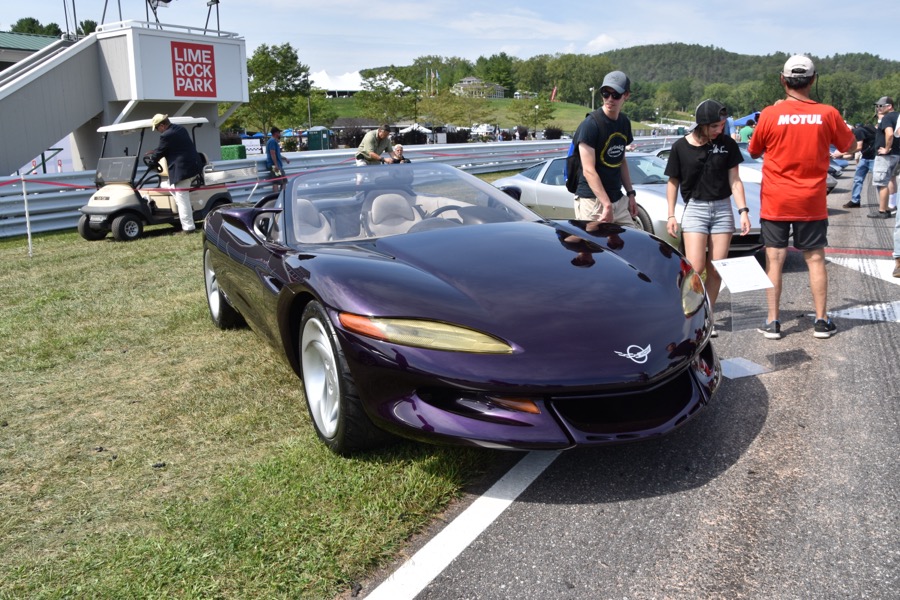
In 1989 GM's design chief made three studios fight over the next Corvette. The one he liked best came from a brand-new studio in California, and it arrived as this: a deep-purple roadster with the windshield hauled forward and the tail chopped off. It lost the competition. Look at the back of any C5 convertible and you'll see how much of it won anyway.
A competition, 1989
The C4 was aging and the C5 had to be got right. GM design chief Chuck Jordan ran an internal competition between three studios to style it, and his own favourite came from the newly established Advanced Concept Center in Southern California — a studio deliberately set up far from Detroit to think differently. John Schinella ran it. John Mack did most of the exterior, Jon Albert the interior. Their proposal became the Sting Ray III.
It is a genuine rethink of Corvette proportions rather than a restyle. The wheelbase went out by 6.7 inches and the width by 3.3; the tail was bobbed by about four inches; and the steeply raked windshield was pulled dramatically forward, which is what gives the car its cab-forward stance. Inside, the seats were fixed and the steering wheel and pedals moved to fit the driver — an idea the industry is still circling. Add a pop-up rollbar, four-wheel steering, and active suspension reading the road through optical sensors.
Sting Ray III at a glance
- Built: one, 1992 — GM's Advanced Concept Center, Southern California
- Team: John Schinella (studio), John Mack (exterior), Jon Albert (interior); competition run by Chuck Jordan
- Proportions: +6.7 in wheelbase, +3.3 in width, tail shortened ~4 in, windshield raked far forward
- Engine: conceived around a high-output V6; the running car got the 5.7L LT-1 V8, 300 hp
- Tech: fixed seats with adjustable wheel and pedals, pop-up rollbar, four-wheel steering, optically-sensed active suspension
- Killed by: a $300,000-plus estimated price — impossible for a Chevrolet
Losing, and winning anyway
It was considered for production and the number came back at more than $300,000. That is not a Chevrolet, and that was that.
But design competitions rarely end cleanly, and the C5 that reached showrooms was a blend of all three proposals. The Sting Ray III's contribution is the part you can still put your hand on: its rear decklid and taillight assemblies were reworked and carried onto the C5 convertible, the fixed-roof coupe, and the C5 Z06. A California concept that was too expensive to build ended up supplying the back end of one of the best-selling Corvettes ever made.
It also earns its name honestly. The Sting Ray was the production car; the Stingray Racer was Bill Mitchell's; the Manta Ray closed out his sea-creature line. The Sting Ray III is the name arriving one last time, thirty years on, in a studio three thousand miles from where it started.