VetteFacts · Tech
Corvette Tech
The year pages throw around a lot of engineering in passing — hydroformed frames, torque tubes, magnetic ride. Here's what those terms actually mean, and why each one made the car better.
Jump to
- Hydroforming
- The torque tube
- Rear transaxle
- Magnetic Ride
- Active Handling
- Run-flat tires
- Dry-sump oiling
- Flat-plane crank
- Z51 package
Hydroforming
When Chevrolet set out to fix the one thing everyone complained about in the C4 — a frame that flexed, creaked, and rattled — the answer turned out to be a metal-forming process borrowed from aerospace and plumbing: hydroforming.
Instead of stamping a frame rail out of several flat pieces of steel and welding them together, hydroforming starts with a single seamless steel tube. The tube is laid inside a precisely machined die shaped like the finished rail, and then water is pumped inside it at enormous pressure — around 7,000 psi — until the metal swells outward and takes the exact shape of the die. One press cycle, one part.
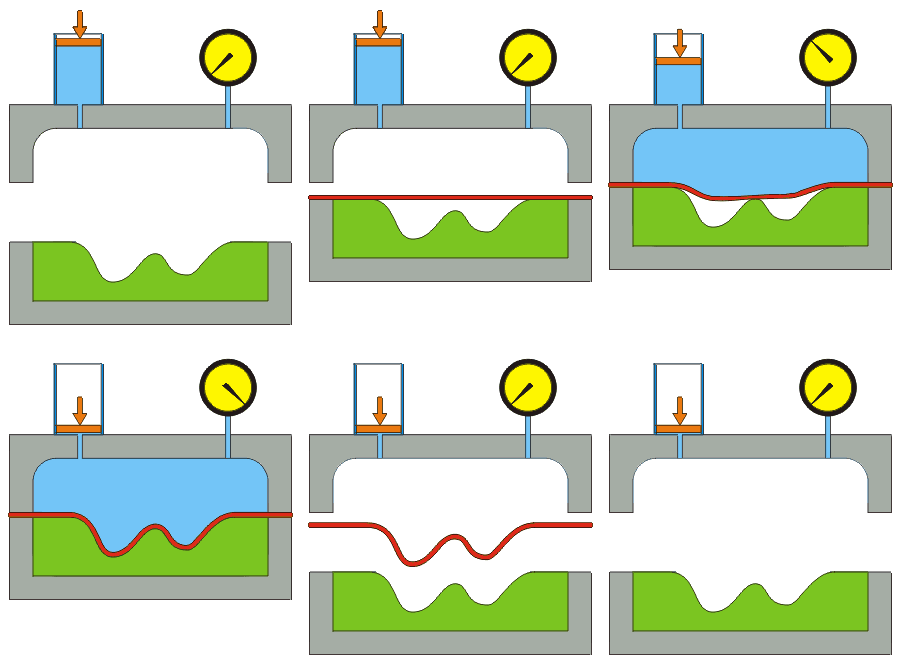
For the C5, that let Chevrolet form each side rail as a single continuous tube nearly the length of the car, in place of the 14 separate welded pieces each C4 rail had required. Every weld is a spot where metal can flex and fatigue, so deleting them made the structure dramatically stiffer: the C5 coupe measured roughly 720 kN/rad of torsional rigidity against about 214 for the C4 — more than triple, and stiff enough that the convertible no longer needed extra reinforcement to feel solid. The rails were also lighter and far more consistent, because a die-formed tube comes out identical every time where a welded assembly drifts.
Hydroformed rails carried the Corvette through the C5, C6, and C7 generations, and they're a big part of why those cars feel so much more solid than the C4 before them.
The torque tube
From the C5 through the C7, the Corvette used an unusual layout for a front-engine car: the transmission wasn't bolted to the back of the engine. It sat all the way at the rear, combined with the differential into a single unit called a transaxle. The part that ties the two ends together is the torque tube.
A torque tube is exactly what it sounds like — a rigid metal tube. It bolts solidly to the back of the engine at one end and to the transaxle at the other, turning the engine and the rear-mounted gearbox into one continuous, structurally stiff assembly. Running down the middle of that tube is a slim driveshaft that carries the engine's power rearward. Because it spins at engine speed rather than at torque-multiplied wheel speed, the shaft can be thin and light.
Two big benefits fall out of this. First, moving the transmission's mass to the rear axle balances the car — the C5–C7 sit close to a 50/50 front-to-rear weight split, which is a large part of why they handle the way they do. Second, rigidly bolting the engine and transaxle together (instead of linking them with a conventional open driveshaft and U-joints) makes the whole powertrain behave as one solid piece, cutting driveline flex and vibration.
The one quirk owners notice: on manual-transmission cars, that rigid connection can transmit a light gear rattle at idle. It's normal, and not a sign of trouble.
Rear transaxle
A transaxle combines the transmission and the axle's differential into one housing. Most front-engine, rear-drive cars keep the transmission up front behind the engine and run a driveshaft back to a separate differential. The C5–C7 Corvette instead put the whole gearbox at the back, bolted to the differential and linked to the engine by the torque tube above. The payoff is weight distribution: with the heaviest driveline component sitting over the rear wheels, the car balances close to 50/50.
Magnetic Ride (Magnetic Selective Ride Control)
Introduced on the Corvette in 2003, Magnetic Selective Ride Control replaces the fluid in the shock absorbers with a magnetorheological fluid — oil filled with microscopic iron particles. Run an electric current through a coil in the shock and the particles line up, instantly thickening the fluid and firming the damper; cut the current and it flows freely again. The system reads the road hundreds of times per second and adjusts each corner independently, so the same car can ride softly on the highway and firm up for hard cornering with no mechanical valves to move. It remains one of the fastest-reacting suspensions in the industry.
Active Handling
Active Handling is Chevrolet's name for electronic stability control on the Corvette. Sensors watch the steering angle, the car's yaw (how fast it's rotating), and individual wheel speeds; if the car starts to slide more or less than the driver is asking for, the system brakes individual wheels — and, in later versions, trims engine power — to bring it back into line. Its track-focused settings let the car rotate more before stepping in, and it can be switched off entirely for experienced drivers.
Run-flat (EMT) tires
Because the rear transaxle layout leaves no room for a spare, most C5–C7 Corvettes ride on run-flat tires — Extended Mobility Tires (EMT). Stiff, reinforced sidewalls let the tire carry the car's weight even with no air in it, so a puncture doesn't strand you: you can keep driving a limited distance at reduced speed to reach help. The trade-off is a firmer ride and more weight at each corner than a conventional tire.
Dry-sump oiling
A conventional engine keeps its oil in a pan at the bottom and picks it up with one pump. Under hard cornering, braking, and acceleration, that oil sloshes away from the pickup and the engine can momentarily starve. A dry-sump system stores the oil in a separate tank and uses extra scavenge pumps to keep it circulating no matter how hard the car is cornering. Fitted to the high-performance Corvettes (Z06, ZR1, and others), it guarantees oil pressure at the cornering forces those cars can generate — and lets the engine sit lower in the chassis.
Flat-plane crankshaft
Most American V8s use a cross-plane crankshaft, with the connecting-rod journals arranged 90 degrees apart — that's what gives a traditional V8 its lopey rumble. A flat-plane crank spaces them 180 degrees apart, like two four-cylinders sharing a crankshaft. It spins up faster and revs higher, at the cost of more vibration, and gives a sharper, higher-pitched exhaust note closer to an exotic. The C8 Z06's LT6 uses one to rev all the way to 8,600 rpm.
Z51 Performance Package
Z51 isn't a single part — it's an order-code package of track-oriented upgrades that has appeared on the Corvette for decades. The exact contents change year to year, but the theme is constant: stiffer springs and bars, firmer or upgraded dampers, better brake cooling, revised gearing, and often improved tires and coolers. It's the factory's answer for a buyer who wants a sharper, track-capable car without stepping all the way up to a Z06.
Suggest a term
Run across a bit of Corvette engineering on the site that isn't explained here? Tell us what to add — send us your idea and we'll work it in.