Rare Corvettes · One of one
The Bertone Ramarro
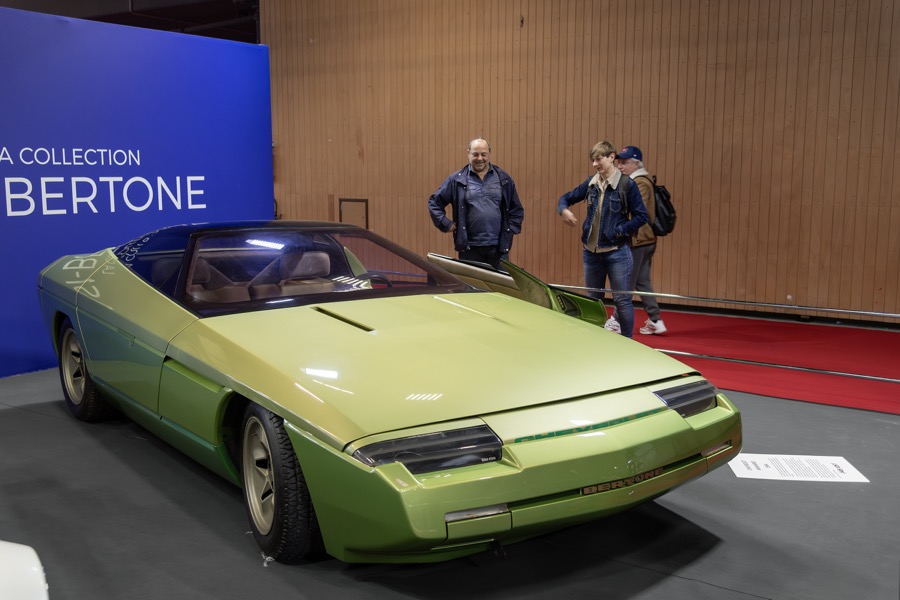
Ramarro is Italian for green lizard, which tells you the colour and almost nothing else. What Bertone actually did in 1984 was take a brand-new C4 Corvette, move the radiator to the back of the car, hang doors that slide forward instead of swinging out, and hand the result back to America with a message attached: this is what your sports car could look like.
Los Angeles, 1984 — a matter of billing
The Ramarro exists partly because of wounded pride, and the story is better for it. Most cars wearing Bertone-designed bodies were sold in America under someone else's badge — the automaker's name first, Bertone's second, if at all. Nuccio Bertone wanted a car to show in America that carried his name first. He also, by all accounts, simply liked the challenge. So his studio took the most American sports car there is and rebuilt it, and debuted the result at the 1984 Los Angeles Auto Show.
The donor was not just any C4. The Ramarro was built on the chassis of the very 1984 Corvette that Chevrolet had used to introduce the C4 to the European press at the 1983 Geneva show. Chevrolet supplied a port fuel-injected V8 from the newer 1985 car. The designer was Marc Deschamps — who, six years later, would do the whole thing again and put the engine behind the seats in the Nivola.
Ramarro at a glance
- Built: one, by Bertone — debuted at the 1984 Los Angeles Auto Show
- Designer: Marc Deschamps, for Nuccio Bertone
- Basis: the 1984 C4 Corvette chassis used to launch the C4 to Europe at Geneva in 1983; a 1985-spec port-injected V8
- The trick: radiator and air conditioning relocated to the tail; the spare tire moved ahead of the engine
- The doors: slide forward toward the nose — usable in a tight parking space
- Tires: experimental Michelins — 240/45VR-17 front, 280/45VR-17 rear
- Award: Auto&Design's Car Design Award, 1985
Engineering as sculpture
The Ramarro's best idea is invisible in photographs. Every front-engined car of the era had the same problem: the radiator needs air, air needs an opening, and the opening dictates the nose. Bertone simply refused the premise. The radiator and the air conditioning went to the back of the car, into the space where the spare tire had lived; the spare moved forward, ahead of the engine. With nothing left to cool up front, the nose could be tapered and sealed off almost completely — cleaner air, lower hood, and a face unlike anything else on the road.
The doors are the party trick. Rather than swinging outward, they slide forward along the body toward the nose — which means you can open them fully in a parking space where a conventional door would hit the car beside you. Add the glazed, bubble-like roof and a set of experimental Michelins, and the Ramarro came out shorter and lighter than the Corvette it was built from.
It worked. The show crowd loved it, and in 1985 Auto&Design gave the Ramarro its Car Design Award, crediting the bold ideas that gave the Corvette “an entirely new personality.” It is the first half of a two-part Italian argument about America's sports car: the Ramarro repackaged the C4 without moving its engine, and then the Nivola moved the engine and finished the thought — three decades before the C8 agreed with them both.