Corvette Racing · The privateer era
The Greenwood Widebodies
Before the factory came back to racing, the wildest Corvettes on any track in the world were built by one man in Michigan. John Greenwood's wide-body C3s were louder, wider, and more outrageous than anything Detroit would dare put on a show stand — and they were genuinely fast.
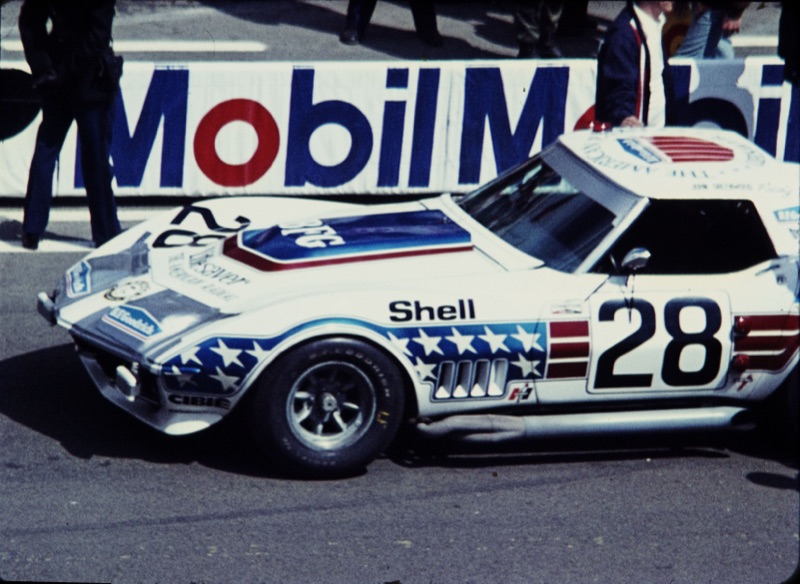
John Greenwood was a rare double threat — a genuinely quick driver who was arguably even better as a constructor. Through the 1970s he turned the third-generation Corvette into a wide-body IMSA weapon that became an American racing icon: fiberglass fender flares stretched to cartoonish widths over enormous tires, a ground-effect undertray and diffusers that made it one of the very first true ground-effect race cars, an acid-dipped full-frame chassis by Ron Fournier, and coil-over suspension designed by Bob Riley.
There's a name in the development story that ties Greenwood straight back to the rest of this site: Zora Arkus-Duntov himself helped develop the fender flares, with designer Randy Wittine on the aerodynamics. The father of the Corvette, lending a hand to a privateer building the widest Corvettes ever made.
The famous cars
- “Spirit of Sebring '75” — Greenwood's own test mule, white with an American-flag hood, a Kinsler-injected big-block making over 700 hp; John won the 1974 IMSA title in it
- “Spirit of Sebring '76” — built in 1975 for wealthy amateur Jim Levitt, campaigned through the 1976 IMSA season
- “Stars and Stripes” — the 1973 Le Mans car, a 1969 L88 fitted with a ZL1 engine, around 700 hp
Le Mans, wide open
Greenwood took the Corvette back to Le Mans more than once. He ran in 1972, returned in 1973 with the L88-based, ZL1-powered “Stars and Stripes” car, and in 1976 put a customer Greenwood Corvette on the IMSA-class pole and recorded the fastest trap speed of the entire race — 215.6 mph down the Mulsanne straight. For a fiberglass American car built in a privateer shop, on a circuit ruled by European factories, that number was a statement.
The Greenwood Corvettes are the loud, flared, star-spangled heart of the Corvette's privateer racing era — the bridge between the order-sheet race cars of the 1960s and the factory Corvette Racing dynasty that would follow.