People · Zora Arkus-Duntov · Chapter 4 of 11
The Letter
Waldorf-Astoria Hotel, New York City — January 1953
The ballroom is dressed like the future. General Motors' Motorama is equal parts auto show, Broadway revue, and religious revival, and this year the altar piece is a low white roadster with a mesh-stone grille of chrome teeth and a name borrowed from a fast little warship: Corvette. The crowd around the turntable is ten deep. Somewhere in that crowd stands a 43-year-old engineer from Fairchild Aviation with a hyphenated Russian name, looking at the prettiest American car he has ever seen — and mentally disassembling it. (The man responsible for the car on that turntable is watching the same crowd from the back of the room — read Harley Earl's side of this same night.)
Harley Earl, GM's imperial styling chief, had willed this car into existence to answer the Jaguars and MGs American servicemen brought home from Europe. As sculpture, Zora judged it superb. As machinery, he knew what lived under the fiberglass: a wheezing "Blue Flame" six descended from truck engines, a two-speed Powerglide automatic — the running gear of a sedan wearing a racing driver's clothes. Beautiful. And a fraud. And, crucially: fixable.
So he went home and did the most Zora thing imaginable. He wrote to Chevrolet's chief engineer, Ed Cole — a complete stranger — praising the car's beauty, observing that it deserved engineering to match, and enclosing, as a calling card, a technical paper proposing an analytical method for calculating a car's top speed. It was equal parts love letter, job application, and dare.
Cole's lieutenant Maurice Olley — the courtly English suspension savant who had laid out the Corvette's chassis — was impressed enough to invite him to Detroit. On May 1, 1953, Zora Arkus-Duntov reported for work at Chevrolet Research and Development: title, assistant staff engineer; salary, modest; mandate, nothing in particular to do with the Corvette at all.
The memo — December 16, 1953
Seven months into the job, the new hire sent his bosses a document with one of the great deadpan titles in industrial history: “Thoughts Pertaining to Youth, Hot Rodders and Chevrolet.” Its argument was heresy dressed in engineering prose. The hot rodders — the very outlaws Detroit executives crossed the street to avoid — were the most passionate car experts in America, Zora argued, and every one of them was building Fords, because thirty years of cheap flathead V8s had created an entire speed-parts industry around the oval. He knew this better than any man alive; his Ardun heads were that industry. If Chevrolet's gorgeous new V8 could be fed into that culture — parts, papers, factory blessing — a generation of young buyers would follow the speed. Racing wasn't a stunt. It was marketing with a stopwatch.
The memo circulated upward and became quiet scripture; Chevrolet's entire performance posture for the next two decades — and arguably the small-block aftermarket that thrives seventy years later — grew from its logic.
The patient nearly dies on the table
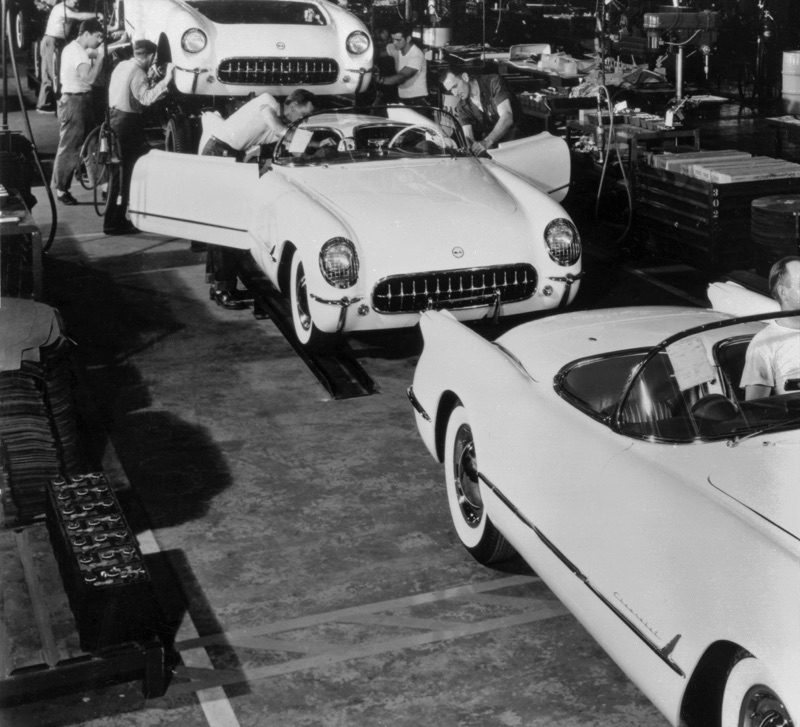
Here is the part modern fans forget: the Corvette almost didn't survive long enough to be saved. The 1953 run of 300 hand-built cars went to celebrities and insiders; the 1954 production of 3,640 met a public that had discovered the car was all show. Nearly a third sat unsold at year's end. For 1955, Chevrolet built just 700. Inside GM, the accountants sharpened their pencils; the only things keeping the program alive were corporate pride — Ford had just launched the Thunderbird, and GM does not retreat in public — and a handful of true believers, Cole and Zora foremost among them.
On October 15, 1954, Zora put the diagnosis on paper in a second landmark memo: the car was neither fish nor fowl — not comfortable enough for boulevard duty, not capable enough for sport — and only a genuine performance identity could save it. The prescription: Cole's brilliant new 265-cubic-inch V8, real gearboxes, and a public demonstration that the Corvette could do something.
The V8 arrived for 1955, transforming the car's character if not yet its image. And that same summer came a detail that tells you everything about how Zora operated: in June 1954, twelve months into his GM career, he had taken leave to co-drive a factory Porsche 550 Spyder at Le Mans — and won the 1.1-liter class. A sitting Chevrolet engineer, collecting class silverware for Stuttgart. He saw no conflict whatsoever. Speed was speed.
Now all he needed was a stage on which to prove the American car. He chose two: a mountain in Colorado, and a beach in Florida.