People · Zora Arkus-Duntov · Prologue
Nassau, December 1963
Oakes Field Course, New Providence Island, The Bahamas — Speed Week, 1963
The Cobras come off the transporter like champions, because that is what they are. All season long, Carroll Shelby's snakes have done to the Corvette exactly what Shelby promised they would: beaten it, everywhere, until the results stopped being news. Nassau Speed Week is supposed to be the victory lap — sun, rum, casino chips, and another row of trophies. Then somebody notices what John Mecom's crew is rolling out of the hangar across the paddock.
There are three of them, painted in the young Texas oilman's blue livery, and from thirty feet they almost pass for Corvette Sting Rays. Almost. The fenders bulge like a fighter's forearms over tires far too wide for anything Chevrolet sells. The bodywork sits paper-thin over a birdcage of thin-wall tubing. And when the first one lights off, the sound is wrong — harder, angrier, a 377-cubic-inch all-aluminum V8 that exists in no catalog, rated by nobody, built for no production car on Earth.
The men in Shelby American jackets walk over for a closer look, and the weekend quietly changes shape.
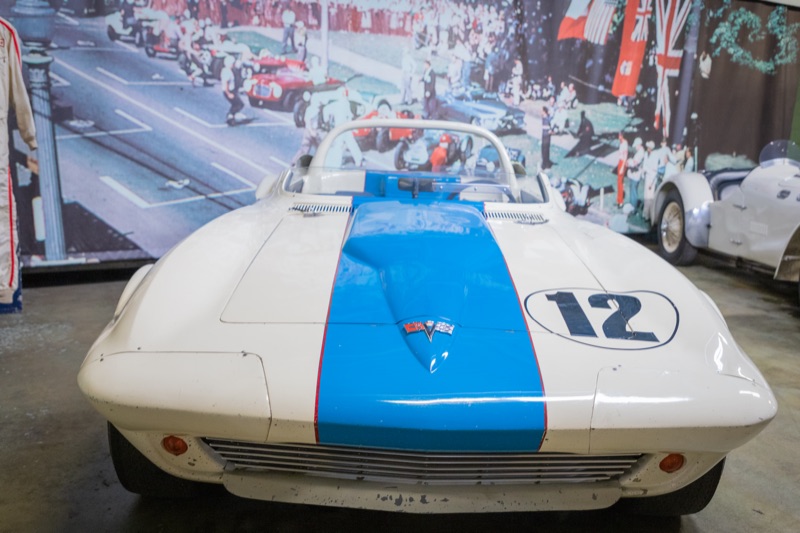
On track, it isn't a race; it's an exhibition. The blue cars — driven by a rotating squad that includes Roger Penske, Jim Hall, Augie Pabst, John Cannon, and a mild-mannered Washington, D.C. dentist named Dick Thompson — run away from the Cobras at a rate of roughly ten seconds a lap. Ten. Motorsports writer Leo Levine would put it drily:
“The Chevrolet equipment won so easily, there was even some embarrassment.” — Leo Levine, on Nassau Speed Week 1963
The embarrassment was real, and it wasn't only Shelby's. Because here is the strange, delicious truth of that December week: General Motors — the largest industrial corporation on the planet — had solemnly sworn off racing six years earlier, and had killed the very program that created these cars. Officially, the three blue monsters did not exist. Officially, the squad of Chevrolet R&D engineers who happened to be in Nassau that week, with suspiciously well-stocked toolboxes, were all just… on vacation. In December. Together.
And the man ultimately responsible — a 54-year-old Russian émigré with a boxer's nose, a chain-smoker's rasp, and an accent that bent English into wonderful new shapes — was, officially, on vacation too.
His name was Zora Arkus-Duntov. He had escaped a revolution and a world war, hot-rodded the Ford flathead into legend, won his class at Le Mans twice, and talked his way into General Motors with a letter. Chevrolet never asked him to make the Corvette a weapon. He simply refused to let it be anything less — through five corporate bans, six chief executives' worth of politics, and thirty years of being told no.
The five illegal lightweights of Nassau are the middle of the story. It begins half a century earlier and half a world away, in a city about to devour itself.