People · Zora Arkus-Duntov · Chapter 8 of 11
The Lightweights
Chevrolet Engineering, Warren, Michigan — late 1962
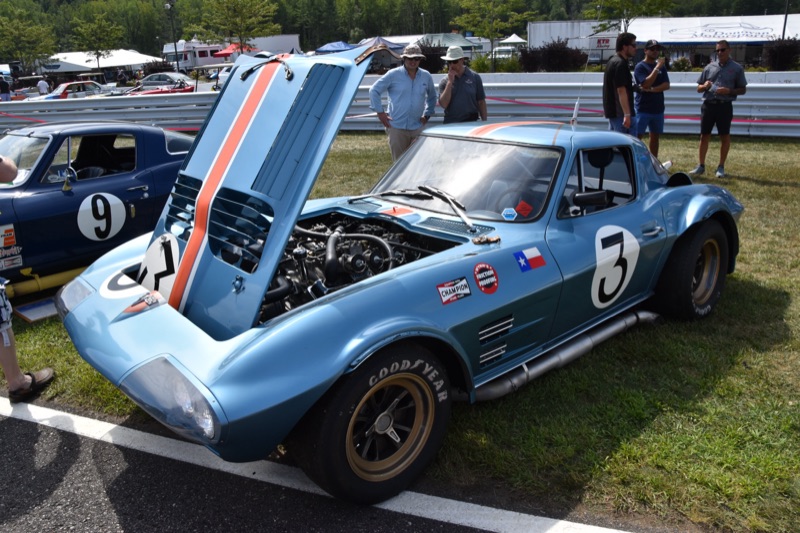
The plan is audacious even by Zora's standards. International GT rules require a manufacturer to build 125 examples of a car to make it legal for the world championship — the arena where Ferrari reigns and Shelby's Cobra is coming. So: build 125. Not modified Sting Rays — replicas in silhouette only. Under the familiar shape: a hand-built tubular ladder frame, paper-thin fiberglass, no bumpers worth the name, every panel and bracket interrogated for grams. Target weight: down around a thousand pounds lighter than the production coupe. Planned heart: a 377-cubic-inch all-aluminum V8 designed to make well north of 500 horsepower. The car has no official name for a while. History will call it the Grand Sport.
Remember: factory racing is still banned. Zora's program lives in the seams of the org chart — sympathetic bosses at Chevrolet looking carefully the other way, parts and manpower borrowed under headings like “engineering study.” The first cars come together in the winter of 1962–63, and the plan is to quietly seed them with trusted private teams while the 125-car run grinds toward homologation.
The fourteenth floor finds out
It lasts until word reaches GM's executive suite. Chairman Frederic Donner's corporation has promised Washington and the public that it does not race — and here is Chevrolet R&D running a covert homologation program for a world championship assault. The order comes down like winter: shut it down. All of it. Now.
Five chassis exist. Five. The aluminum 377 isn't ready; the 125-car dream is ash. By any corporate logic the five orphans should have been crushed. Instead — in the great tradition of Zora's career — they leak out the side door, sold or lent to exactly the sort of “private” customers who happen to be the best-connected racers in America: John Mecom's Texas team, Roger Penske, Jim Hall, Dick Doane, Grady Davis of Gulf Oil. Cars that officially should not exist begin appearing at circuits, driven by future legends, hounded by Cobras — and developed, race by race, by a factory that officially isn't there.
Nassau, The Bahamas — December 1963
You have seen this scene — it opened this story. Now you know what you were looking at. Mecom's hangar. Three Grand Sports, freshly fitted at last with the 377 aluminum engines they were always meant to have, flared to swallow massive tires. Penske, Hall, Thompson, Cannon, Pabst trading stints. A supporting cast of Chevrolet engineers on suspiciously simultaneous Caribbean “vacations,” toolboxes packed. And the Cobras — all-conquering all season — suddenly ten seconds a lap behind and shrinking in the mirrors.
“The Chevrolet equipment won so easily, there was even some embarrassment.” — Leo Levine, motorsports historian
For one warm December week, the world saw exactly what Zora had designed: not a modified Corvette chasing Cobras, but a purebred that made them look ordinary. Word of the Bahamian ambush reached the fourteenth floor almost as fast as it reached the sports pages — and this time the shutdown stuck. Early in 1964 the hammer fell again, harder: no parts, no engineers, no vacations. The five cars scattered into private hands for good, campaigned on by Penske and others, gloriously, on their own.
The five, forever
- All five Grand Sports — chassis 001 through 005 — survive today, the most valuable Corvettes in existence; #002 lives at the Revs Institute.
- Two (001 and 002) were later cut into roadsters for high-speed work at Sebring and Daytona.
- The “Grand Sport” name has been resurrected by Chevrolet in 1996, 2010, 2017 — and again for 2027, this time with Nassau-blue heritage colors available. See the 2027 model year page.
- Zora also built the CERV II in 1964 — an all-wheel-drive, aluminum-377 mid-engine prototype aimed at Le Mans — killed by the same policy before it ever raced. He kept the lesson.
The Grand Sport is the tragedy at the center of Zora's American career: the clearest proof of what he could do with the leash off, and the definitive demonstration that the leash would never come off. He was fifty-four. A lesser man would have made peace with building fast sedans.
Zora made other plans. If GM wouldn't let him race the company's cars, he would put racing engines in the customers' hands — and if the front-engine Corvette had reached its limit, he would spend the rest of his career building the case for the car that came next.