People · Bill Mitchell · Chapter 5 of 6
Sharks and Coke Bottles
GM Styling — 1961–1965
The mounted mako shark from the prologue doesn't stay a curiosity for long. With the 1963 Sting Ray's design already locked, Mitchell has Larry Shinoda turn the shark's exact color gradient and predatory, tapered nose into the Mako Shark I — internally the XP-755 — a show car whose paint alone required matching a dead fish stroke for stroke, and whose pointed, aggressive snout previews a design language the Sting Ray hasn't fully embraced yet. It's a statement of where Mitchell's eye is heading, not a finished production plan.
That plan arrives in 1965, when the Mako Shark II debuts at the New York International Auto Show to considerable fanfare. It pushes the shark motif further and adds the detail that will define the entire next Corvette generation: dramatically flared fenders swelling out over the front and rear wheels, pinched tight through the middle — a silhouette the press and public immediately nickname the “Coke-bottle” shape. It is, by every account, entirely Mitchell's idea, pushed through his studio with the same stubbornness that had won him the split-window fight two years earlier. And by every account, it drives Zora Arkus-Duntov up the wall for entirely practical reasons: those swollen fenders add width, weight, and aerodynamic drag that a chassis engineer would never have chosen on his own.
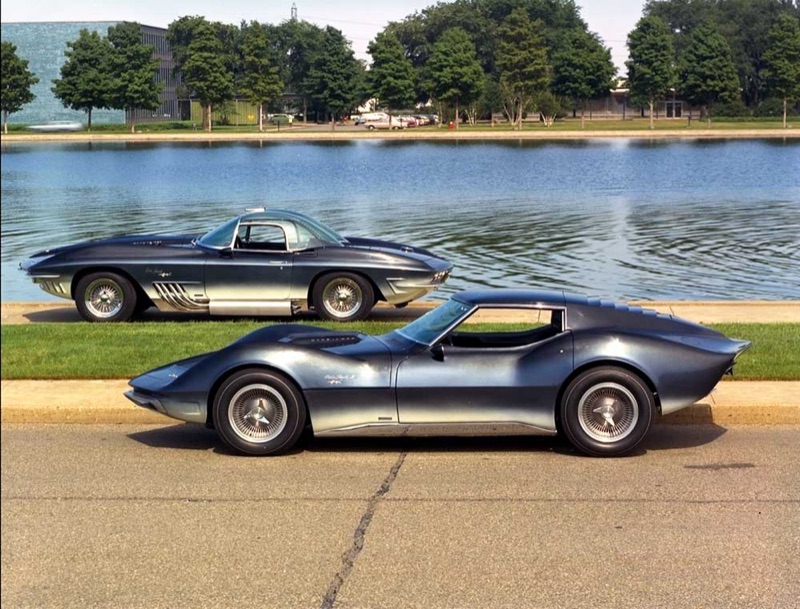
Duntov's objections don't win this round. When the third-generation Corvette arrives for 1968, its flared, curvaceous fenders are the Mako Shark II's design translated almost directly into steel and fiberglass reality — the “Coke-bottle” look becomes the defining visual signature of the entire C3 generation, produced for fifteen years, through 1982. Mitchell's shark had, in every sense that matters to a design chief, won.
A fish caught off Bimini reshaped Corvette fenders for the next fifteen years of production.
It is the clearest possible demonstration of the difference between the two men running the Corvette program by the mid-1960s. Duntov measured a shape by what it let the car do. Mitchell measured it by whether it looked like it had always been inevitable. Both approaches had, by 1968, made the Corvette faster, stranger, and more famous than it had ever been — proof that their fights, however loud, were making the car better rather than merely wearing each other down.